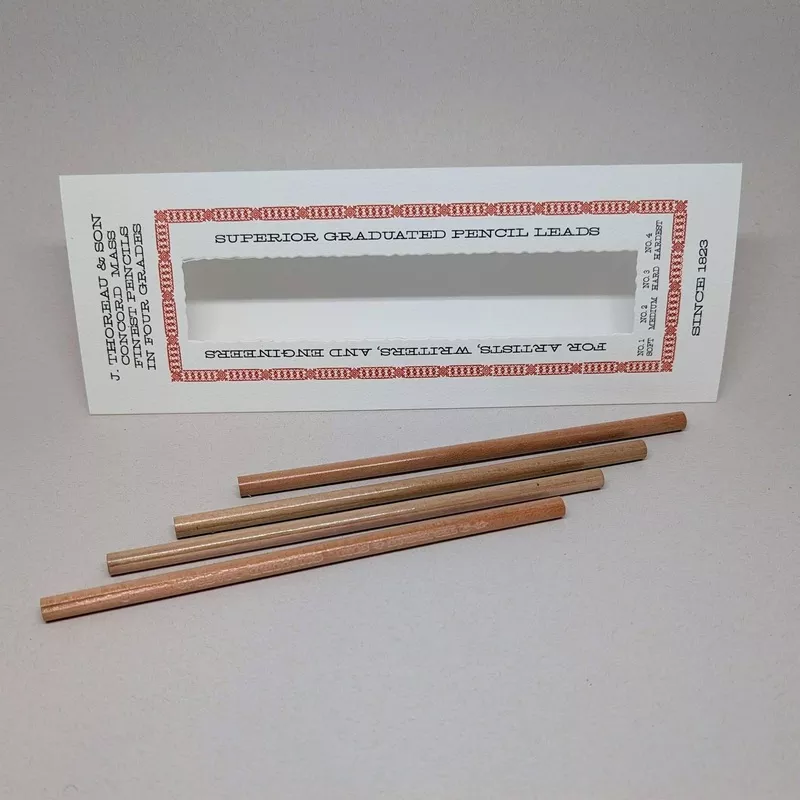
Set of 4 wooden pencils with different graphite grades.
A little history of the Thoreau pencil:
John Thoreau entered the pencil business in 1823, after his brother-in-law discovered a vein of plumbago, or graphite, in New Hampshire. Thoreau & Co. quickly gained recognition for their high-quality pencils. By 1829, their pencil manufacturing moved to Concord, MA.
Johns son, Henry David Thoreau, became involved in the business and started to dig into the manufacturing problems that had made American pencils notoriously inferior to European imports. After researching it at the Harvard Library in 1840, he hit upon the idea of using clayrediscovering what the French had figured out 45 years earlierto make the perfect graphite mix. Henrys formula for kiln-fired pencil leadsa mix of finely ground graphite and claycould be reliably graded from hard to soft. John Thoreau & Co. was the first American pencil manufacturer to market pencils using a standard of hardness, graded 1-4.
The improved Thoreau product appealed especially to engineers, surveyors, carpenters, and artists who valued its consistency. In 1844, Henry made another breakthrough, inventing a grinding machine that produced exceptionally fine graphite powderthe key to a strong, even point. Thoreau pencils won more awards in 1847 and 1849. No one in the United States made better pencils than the Thoreaus, and the reason for their success was Henry. Around 1849 John Thoreau changed the name of the family business from J. Thoreau & Co. to J. Thoreau & Son.